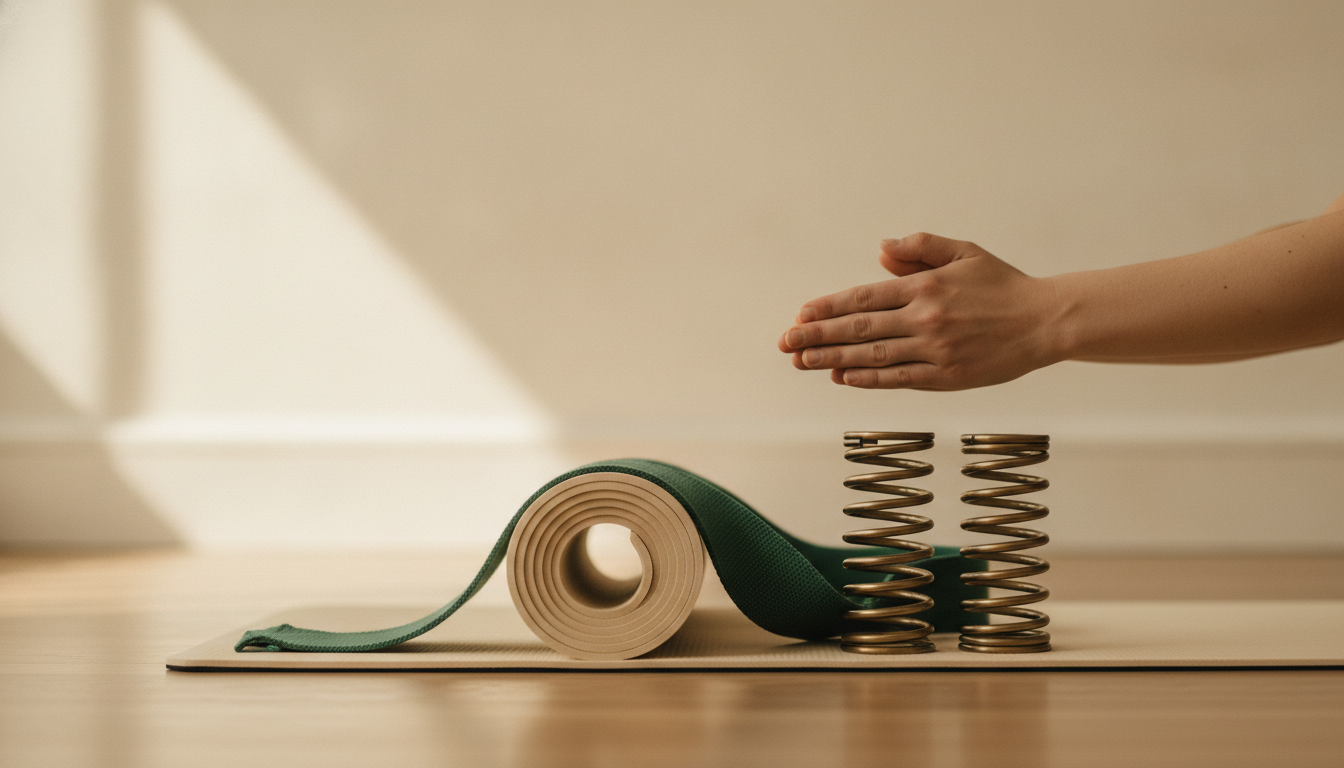
The question of whether Pilates or Yoga is better is common, and the answer is simple: it depends entirely on you and your goals. Pilates is generally better for building deep core strength, improving posture, and targeted muscle control. Yoga often has the edge for increasing overall flexibility, reducing stress, and exploring a spiritual connection through movement.
Both are powerful mind-body disciplines that can transform your physical and mental well-being. This guide will walk you through their origins, methods, and specific benefits to help you decide which path—or perhaps a combination of both—is the right one for you.
Core Philosophies: Where They Come From
Understanding the origins of each practice reveals the fundamental difference in their approach.
The Origins of Pilates
Pilates was developed in the early 20th century by Joseph Pilates. A German physical trainer, he created his method, which he called “Contrology,” to help rehabilitate fellow internees during World War I and later, dancers in New York City. His system was born from a need for functional strength and resilience.
The core philosophy of Pilates is the idea that the mind can be used to control the body's muscles. It’s built on six key principles:
- Centering: Focusing on the center of the body—the powerhouse—from which all movement originates.
- Concentration: Bringing full attention to each movement to maximize its benefit.
- Control: Maintaining complete muscular control throughout every exercise.
- Precision: Every movement has a purpose and a precise placement.
- Breath: Using breath as a tool to facilitate movement and engage deep muscles.
- Flow: Executing movements with economy, grace, and fluidity.
The ultimate goal is a uniformly developed body with a strong, stable core.
The Origins of Yoga
Yoga is an ancient practice with roots in India stretching back over 5,000 years. It is not just a physical exercise but a comprehensive spiritual and philosophical system. The physical postures, or asanas, are just one of the “Eight Limbs of Yoga.”
The core philosophy of Yoga is to create union (yuj in Sanskrit) between the mind, body, and spirit. It seeks to quiet the fluctuations of the mind and achieve a state of inner peace and enlightenment. The practice uses asanas, breathing techniques (pranayama), and meditation to connect with the present moment. While modern Western yoga often emphasizes the physical workout, its traditional purpose is to prepare the body for long periods of meditation.
The Practice: What to Expect in a Class
While both are often done on a mat, the atmosphere and execution of a class can be quite different.
A Typical Pilates Class
Expect a focus on precision and anatomy. An instructor will provide detailed cues about your form, alignment, and which muscles you should be feeling. The movements are often smaller and more isolated than in yoga, performed in sets of repetitions.
- Atmosphere: Generally more like a personal training session or a focused workout. The language is direct and instructional.
- Equipment: Mat Pilates uses your body weight, often supplemented with small props like resistance bands, magic circles, and light weights. Reformer Pilates uses a large, spring-loaded machine that provides resistance and support, allowing for a vast range of exercises.
- Breathing: The breath is coordinated with movement, typically inhaling to prepare and exhaling on the effort to deepen core engagement.
A Typical Yoga Class
Yoga classes can vary dramatically depending on the style (e.g., Hatha, Vinyasa, Ashtanga). However, most will involve moving through a series of poses, some held statically and others linked together in a flow.
- Atmosphere: Can range from serene and meditative to energetic and powerful. There may be an inclusion of chanting, setting an intention, or a brief philosophical reading. The language is often more invitational and introspective.
- Equipment: A yoga mat is the primary tool. Props like blocks, straps, and bolsters are used to support the body and deepen stretches. At Veda Pilates, we also offer Aerial Yoga, which uses a silk hammock to support your body and allow for unique movements and inversions.
- Breathing: Breath is central and is consciously linked to every movement. It's seen as a source of life force (prana), and specific techniques are used to calm the nervous system or build internal heat.
Pilates vs. Yoga at a Glance
This table summarizes the key distinctions:
| Feature |
Pilates |
Yoga |
| Primary Goal |
Build core strength, align the spine, and create balanced muscle development. |
Unify mind, body, and spirit; increase flexibility and reduce stress. |
| Origin |
Early 20th-century Germany, developed by Joseph Pilates for rehabilitation. |
Ancient India, over 5,000 years ago, as a spiritual and philosophical path. |
| Equipment |
Mat with small props or specialized apparatus like the Reformer. |
Primarily a mat, with props like blocks, straps, and bolsters for support. |
| Breathing |
Breath is a tool to facilitate movement and engage the core (exhale on effort). |
Breath (pranayama) is a central pillar of the practice, used to link poses and calm the mind. |
| Spiritual Component |
Generally minimal; the focus is on the mind-body connection for physical control. |
Integral to traditional practice; often includes meditation, chanting, and philosophy. |
| Pace & Flow |
Movements are precise and repeated in sets, emphasizing control and stability. |
Can be a slow, static hold or a dynamic flow linking a series of poses. |
Goal-Based Breakdown: Which Is Better For You?
Let's compare the two disciplines based on common wellness goals.
For Building Core Strength: Pilates
While both practices strengthen the core, Pilates is specifically designed for it. The entire method revolves around the “powerhouse”—the deep muscles of the abdomen, back, hips, and glutes. Every exercise, whether on the mat or a Reformer, originates from a stable and engaged center. The controlled movements and spring resistance of the Reformer provide a direct path to building profound, functional core strength that supports your entire body.
For Increasing Flexibility: Yoga
Yoga is the clear winner for improving general flexibility. The practice is built around moving the body through its full range of motion. Holding asanas for several breaths allows muscles and connective tissues to lengthen safely. Poses are specifically designed to open tight areas like the hips, hamstrings, and shoulders. While Pilates improves flexibility through dynamic stretching, Yoga’s focus on sustained holds makes it more effective for significant gains in range of motion.
For Weight Loss: It's a Tie (with Caveats)
Neither Pilates nor Yoga is a high-intensity cardio workout that burns a massive number of calories per session. Sustainable weight loss comes from a consistent calorie deficit, achieved through diet and exercise. Both practices can be part of that equation.
- Pilates builds lean muscle mass, which increases your resting metabolic rate, helping you burn more calories throughout the day. A dynamic Reformer class can also be a vigorous workout that elevates your heart rate.
- Yoga in a fast-paced Vinyasa or Power Yoga style can be very physically demanding and burn significant calories. Furthermore, the mindfulness aspect of yoga can help address emotional eating and reduce stress, which is often linked to weight gain.
For weight loss, the best approach is to choose the practice you enjoy most (so you'll stick with it) and combine it with a balanced diet and cardiovascular activity.
For Improving Posture: Pilates
Poor posture often stems from muscular imbalances and a weak core. Pilates directly addresses this by strengthening the deep postural muscles that support the spine. The focus on alignment, pelvic stability, and scapular control retrains your body to hold itself properly. The feedback from a Reformer can be especially helpful in correcting alignment issues you may not be aware of.
For Injury Rehabilitation: Pilates
Pilates was originally created for rehabilitation. Its low-impact, controlled nature makes it an exceptionally safe way to rebuild strength after an injury. The exercises can be precisely modified to target weak muscles without straining vulnerable areas. The Reformer is particularly beneficial, as its springs can provide support to assist movement or add resistance to challenge it, allowing for a finely tuned recovery process. As always, consult your doctor before starting any exercise program post-injury.
For Stress Reduction: Yoga
While the intense concentration of Pilates can be a form of moving meditation, Yoga is purpose-built for calming the mind. The conscious linking of breath to movement, the practice of pranayama (breath control), and the inclusion of meditation directly activate the parasympathetic nervous system—your body's “rest and digest” mode. This process lowers cortisol levels and promotes a profound sense of calm that can last long after you leave the mat.
Can You Do Both? The Synergy of Pilates and Yoga
You don't have to choose. Pilates and Yoga are highly complementary, and practicing both can create a wonderfully balanced fitness routine.
- The deep core stability from Pilates can make your Yoga practice safer and stronger. You'll find more control in balancing poses and better support for your spine in deep twists and backbends.
- The increased flexibility and body awareness from Yoga can enhance your Pilates practice. You'll be able to move with greater range and flow, deepening your connection to the exercises.
At Veda Pilates, we see many clients who benefit from integrating both. Check out our full list of programs to see how you can incorporate Mat Pilates, Reformer Pilates, Mat Yoga, and Aerial Yoga into your week.
Making Your Choice in Ghaziabad
Ultimately, the best practice is the one you enjoy and will do consistently. Consider what you want to achieve. Are you looking to build raw strength and fix your posture? Start with Pilates. Are you seeking flexibility and a way to quiet your mind? Begin with Yoga.
In our boutique studio in Raj Nagar Extension, we offer small group classes in both disciplines. This ensures you get the personalized attention needed to learn the fundamentals correctly and safely, whether you're on a Reformer, a mat, or in an aerial hammock. We serve clients from all over the area, including Raj Nagar, Kavi Nagar, RDC, and Nehru Nagar.
The best way to know for sure is to try them. Feel how your body responds to the controlled precision of Pilates and the mindful flow of Yoga.
There is no universal “better,” only what is better for you. Listen to your body, define your goals, and take the first step.
Ready to find out which practice feels right? The best way to decide is to experience them for yourself. Veda Pilates offers a starting package for just ₹999, allowing you to try a class and see what resonates. Book your first session at our Raj Nagar Extension studio and begin your journey today.