Journal
Reformer vs Mat Pilates: Which Should Beginners Start With?
By Veda Pilates · 25 September 2026 · 9 min read
Deciding between Reformer and Mat Pilates as a beginner? Learn the key differences in support, resistance, and accessibility to choose your ideal starting point.
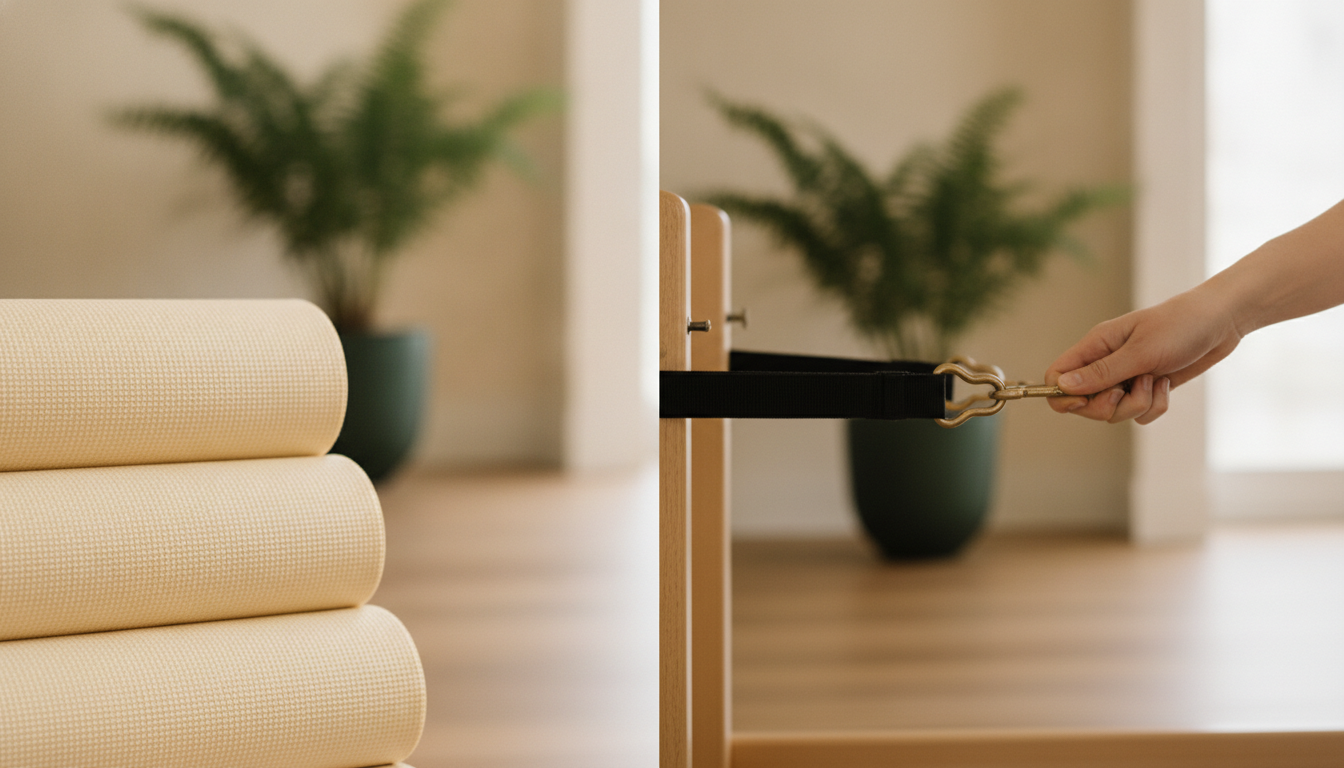
For a complete beginner, both Mat Pilates and Reformer Pilates offer distinct entry points into the practice, each with unique advantages. Mat Pilates is often more accessible, building foundational strength primarily using your body weight, while Reformer Pilates provides spring-based resistance and support, which can be beneficial for learning proper form and targeting specific muscle groups. The choice between them often comes down to personal preference for equipment, the level of external support desired, and individual fitness goals.
At Veda Pilates, our boutique studio in Raj Nagar Extension, Ghaziabad, offers both options in small group, 50-minute classes. This ensures you receive focused attention and guidance, regardless of which method you choose to begin with. We serve clients from Raj Nagar, Kavi Nagar, RDC, and Nehru Nagar, making quality Pilates accessible across Ghaziabad.
Understanding Mat Pilates
Mat Pilates is the original form of Pilates, developed by Joseph Pilates. It involves performing a series of controlled exercises on a mat, using only your body weight for resistance against gravity. The primary focus is on strengthening the core, improving flexibility, enhancing balance, and cultivating precise body control through mindful movement and breathwork. Exercises typically target the deep abdominal muscles, back, hips, and glutes, fostering a strong and stable center.
Benefits of Mat Pilates for Beginners:
- Accessibility and Foundation: Mat Pilates requires minimal equipment, making it highly accessible and an excellent starting point for building fundamental core strength and understanding basic Pilates principles. It teaches you to move your body efficiently without external aid.
- Enhanced Body Awareness: By relying solely on your own body, Mat Pilates develops a profound sense of body awareness and proprioception. You learn to control your movements and engage the correct muscles, which translates into better posture and movement in daily life. This can be particularly helpful for addressing issues like lower back pain from desk jobs or improving overall posture. Learn more about how Pilates can help with posture.
- Core Stability: It directly challenges your deep core muscles, requiring you to stabilize your spine and pelvis. This intrinsic strength is crucial for injury prevention and overall physical performance.
- Mental Engagement: The practice emphasizes concentration and breath, fostering a strong mind-body connection that can reduce stress and improve focus.
- Cost-Effective: Generally, Mat Pilates classes are more affordable than Reformer classes due to lower overhead costs, offering an accessible entry point to the practice.
Mat Pilates exercises, such as The Hundred, Roll-Up, or Leg Circles, demand significant control and stability from your core. This direct challenge against gravity builds resilience and a deep understanding of your body's capabilities, forming a robust foundation for any physical activity.
Understanding Reformer Pilates
Reformer Pilates utilizes a specialized machine called a Reformer, which is essentially a bed-like frame with a sliding carriage, springs, pulleys, and straps. This apparatus allows for a much wider range of exercises than Mat Pilates, which can be performed lying down, sitting, kneeling, or standing. The springs provide adjustable resistance, and in some cases, assistance, making the workout highly versatile and adaptable to various fitness levels and needs.
Benefits of Reformer Pilates for Beginners:
- Support and Assistance: The Reformer's springs can be adjusted to provide support, making certain movements easier to execute with proper form. This can be particularly helpful for beginners who might struggle with body control on the mat or for those with specific physical limitations, allowing them to perform exercises safely and effectively.
- Adjustable Resistance: The variable spring resistance allows exercises to be tailored precisely to individual strength levels. As you progress, the resistance can be increased for a greater challenge, or decreased for assistance, ensuring a continuous and progressive workout.
- Full-Body Conditioning: The Reformer engages muscles throughout the entire body in a coordinated manner. It promotes balanced strength development, improves flexibility, and enhances joint mobility more dynamically than Mat Pilates alone. This makes it an excellent option for comprehensive physical conditioning.
- Precision and Alignment: The machine acts as a guide, encouraging precise movements and optimal alignment. This feedback from the apparatus helps beginners understand correct form and muscle engagement more intuitively, which can accelerate their learning process.
- Dynamic and Versatile: Reformer classes offer a dynamic workout experience with hundreds of possible exercises. This variety keeps classes engaging and allows for diverse programming that can target specific areas or provide a full-body challenge.
The Reformer offers a unique blend of resistance and support, enabling exercises that might be difficult or impossible on the mat. It can help isolate specific muscle groups, lengthen the spine, and improve overall body mechanics, providing a different kind of challenge and benefit compared to Mat Pilates.
Reformer vs. Mat Pilates: A Comparison for Beginners
Here’s a breakdown to help you compare the two methods, highlighting their key distinctions for someone new to Pilates:
| Feature | Mat Pilates | Reformer Pilates |
|---|---|---|
| Equipment | Mat, body weight | Reformer machine (carriage, springs, pulleys) |
| Resistance | Body weight, gravity | Adjustable springs, body weight |
| Support | Minimal, relies on self-stabilization | Significant, machine assists and supports |
| Accessibility | Highly accessible, can be done anywhere | Requires access to a studio with Reformers |
| Intensity | Can be very challenging, requires core control | Highly variable, adjustable for all levels |
| Focus | Core strength, body control, balance, body awareness | Full-body conditioning, precision, flexibility, muscle isolation |
| Typical Cost | Generally more affordable | Generally higher due to equipment and maintenance |
| Experience | Grounded, self-reliant, builds intrinsic strength | Dynamic, guided, offers external challenge and support |
Which Should You Start With?
For a complete beginner, the choice between Mat and Reformer Pilates depends largely on your comfort level, current physical condition, and what you hope to gain initially. Both are effective paths to building a stronger, more flexible body.
- Choose Mat Pilates if: You prefer working with your own body weight, want to build fundamental core strength and body awareness from the ground up, and appreciate the accessibility of the practice. It's an excellent choice if you're looking to improve overall body control and posture, or if you're recovering from issues like lower back pain, as it emphasizes stabilization without external assistance. Explore our range of Pilates programs.
- Choose Reformer Pilates if: You are curious about equipment-based exercise, desire external support to learn movements, or want adjustable resistance to either assist or challenge you. The guided movement of the Reformer can be very reassuring for those new to exercise or those who might have joint limitations, as it allows for a greater range of motion with support. It's also ideal if you're looking for a dynamic, full-body workout with precise muscle targeting.
Many individuals find significant benefit in practicing both Mat and Reformer Pilates, as they complement each other by developing different aspects of strength, control, and flexibility. Mat Pilates hones your internal body awareness and deep core strength, while Reformer Pilates provides external resistance and support to challenge and refine those movements. Combining them can lead to a more comprehensive and balanced fitness regimen.
Starting with a private or duet session can also be an excellent way to get personalized guidance and an introduction to either the Mat or Reformer before joining a group class. This allows instructors to tailor the initial experience to your specific needs and goals.
At Veda Pilates in Ghaziabad, we encourage beginners to explore our diverse offerings. Our small group, 50-minute classes are designed to provide effective and personalized instruction within our boutique studio environment. We also offer a ₹999 starting package, which is a great way to experience our studio and see which format—or combination of formats—resonates most with you. Whether you're in Raj Nagar Extension, Raj Nagar, Kavi Nagar, RDC, or Nehru Nagar, our studio is equipped to help you begin your Pilates journey. Find out more about how Pilates can help with specific concerns like lower back pain.
Ready to discover which Pilates path is right for you? Book a trial class at Veda Pilates in Raj Nagar Extension and experience both options firsthand.