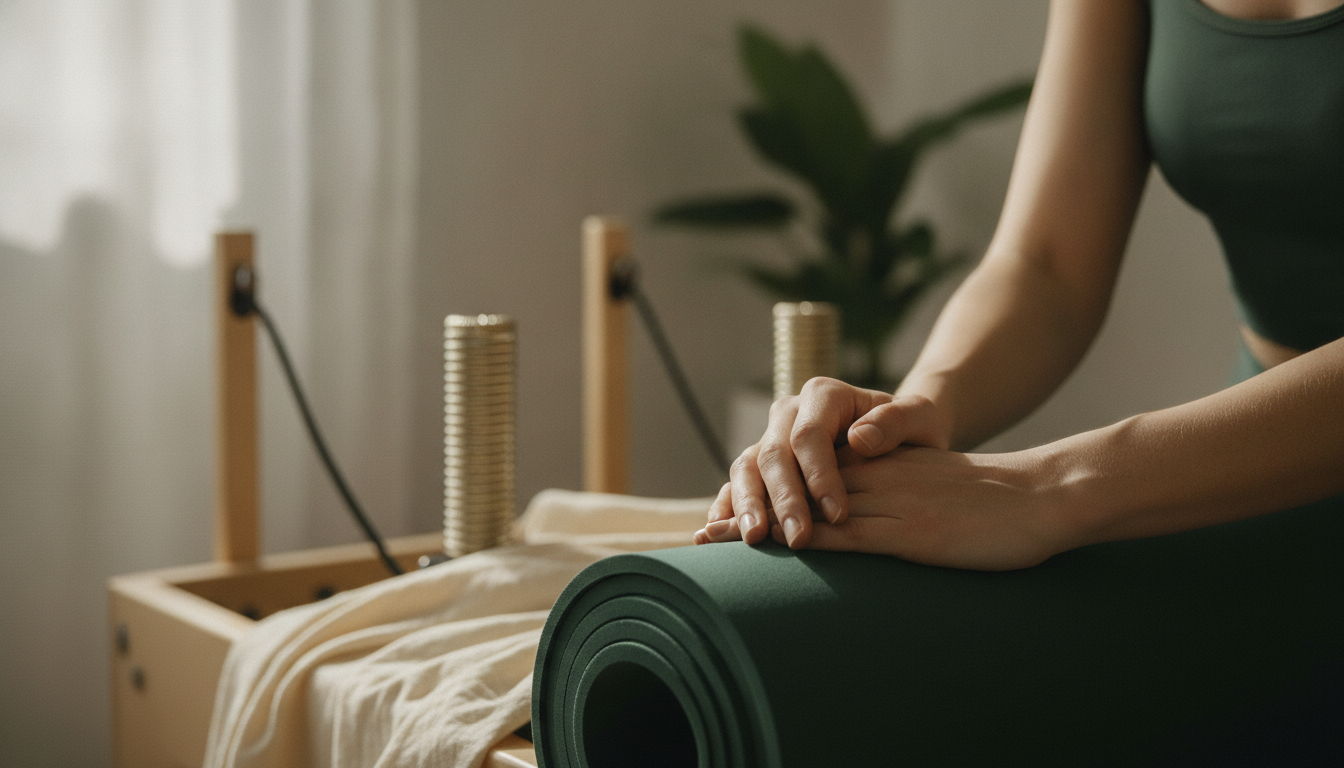
Pilates can be a safe and highly effective form of exercise after a slip disc, provided you have clearance from your doctor and work with a knowledgeable instructor. Its core principles—building deep abdominal strength, improving spinal alignment, and promoting controlled movement—directly address the weaknesses that contribute to and result from a disc injury. This approach helps to create a 'natural corset' of muscle around your spine, reducing load on the injured disc and preventing future issues.
Recovering from a herniated or slipped disc can be a frustrating and cautious process. The fear of re-injury is real, and it's natural to question which activities are safe. While high-impact exercises are off the table, the gentle, precise movements of Pilates can be a cornerstone of your long-term recovery strategy.
Understanding a Slip Disc and the Core's Role in Protection
A 'slip disc' is a common term for a herniated or prolapsed intervertebral disc. These discs are the gel-like cushions between your vertebrae. When the tough outer layer tears, the soft inner portion can bulge out, sometimes pressing on spinal nerves. This can cause pain, numbness, or weakness.
The key to managing and recovering from this is stability. Your spine is designed to move, but it needs a strong support system. This is where your core comes in. We're not just talking about the 'six-pack' muscles (rectus abdominis), but the deep internal muscles that form a protective cylinder around your spine:
- Transverse Abdominis (TVA): The deepest abdominal muscle, which wraps around your torso like a corset. When engaged, it cinches the waist and creates intra-abdominal pressure, stabilizing the lumbar spine.
- Multifidus: A series of small but powerful muscles that run along the spine, connecting individual vertebrae. They provide segmental stability, preventing excessive or shearing movements between each bone.
- Pelvic Floor: The sling of muscles at the base of your pelvis. It works in coordination with the diaphragm and TVA to regulate pressure and support the spine from below.
- Diaphragm: Your primary breathing muscle, which forms the top of the 'core canister'. Proper breathing is the foundation of core stability.
Pilates is uniquely effective at targeting this deep stabilizing system. Unlike traditional gym workouts that might focus on large, superficial muscles, every Pilates exercise originates from this deep core engagement. By strengthening this system, you reduce uncontrolled movement in your lumbar spine, giving the injured disc a stable environment in which to heal.
The Power of Pilates Breathing for Spinal Support
In Pilates, breathing isn't an afterthought; it's central to the movement. We teach a technique often called lateral or three-dimensional breathing. On the inhale, you breathe into the back and sides of your ribcage. On the exhale, you gently engage the TVA and pelvic floor. This coordinated effort creates intra-abdominal pressure, which acts like an internal airbag, decompressing and supporting the lumbar spine. This fundamental skill is the first and most important one you'll learn in your recovery.
The Journey Back: Phases of Recovery and Where Pilates Fits In
Recovery from a disc injury is not a single event but a process. Understanding these phases helps set realistic expectations and shows how Pilates can be integrated safely.
Phase 1: The Acute Stage (Rest and Diagnosis)
This is the initial period following the injury, characterized by significant pain and inflammation. The only goal here is to reduce pain and get a proper diagnosis from a medical professional. Pilates is not appropriate during this phase. Follow your doctor's advice, which typically involves rest and anti-inflammatory measures.
Phase 2: The Post-Acute Stage (Initial Stabilization)
Once the acute pain has subsided and you have medical clearance, you can begin the first steps of active recovery. This is the ideal entry point for post-rehab Pilates. The focus is not on big movements but on re-establishing the mind-body connection to your deep core. Exercises are gentle and performed in a supportive, neutral spine position. Examples include learning proper breathing, gentle pelvic tilts, and isolated leg slides.
Phase 3: The Strengthening Stage (Building Resilience)
As your core stability improves and you can maintain a neutral spine without pain, your instructor will gradually increase the challenge. This might involve adding light resistance with Reformer springs, increasing the range of motion, or introducing movements in different planes (like gentle side-lying work). The goal is to build strength in the muscles that support the spine—the glutes, back extensors, and obliques—without compromising the injured area.
Phase 4: The Functional Stage (Return to Life)
In this final stage, the focus shifts to integrating your newfound core strength into movements that mimic daily life. This means learning to bend, lift, and twist safely. Pilates helps by building endurance and motor control, retraining your body to use its deep core support automatically. This phase is crucial for building confidence and preventing re-injury.
The Golden Rules for Starting Pilates After a Disc Injury
Jumping back into exercise too soon or with the wrong approach can set your recovery back. Follow these non-negotiable rules.
1. Get Medical Clearance
This is the most important step. Your doctor or physiotherapist understands the specifics of your injury—the location, the severity, and the type of herniation. They will tell you when your body is ready for exercise and what specific movements (like flexion or extension) you must avoid. Do not start any Pilates program without their explicit approval.
2. Find a Qualified and Experienced Instructor
This is not the time for a generic group class at a large gym. You need an instructor who understands post-rehabilitation exercise and the biomechanics of spinal injuries. At a boutique studio like Veda Pilates, our small group classes and private sessions ensure you get the personalised attention you need. An experienced instructor will know how to apply the principles of Pilates for recovery.
Before you commit, ask these questions:
- What is your experience working with clients recovering from disc injuries?
- How will you modify exercises for my specific condition and limitations?
- What is your approach to maintaining a neutral spine?
- What should I do if I feel pain or discomfort during a session?
A good instructor will welcome these questions and provide confident, clear answers.
3. Communicate Clearly and Constantly
Be open with your instructor about your diagnosis, your symptoms, and what your doctor has advised. During the class, provide feedback. If you feel any sharp pain, tingling, or numbness, stop immediately and tell them. Your body's signals are the most important guide.
4. Master the Fundamentals First
Before you attempt complex movements, you must master the basics of Pilates breathing and neutral spine alignment. A neutral spine is the natural curve of your back where the vertebrae are under the least amount of stress. An instructor will help you find this position and teach you how to maintain it while moving your limbs—this is the foundation of spinal stability.
Safe vs. Potentially Harmful Pilates Exercises for a Slip Disc
Not all Pilates exercises are suitable during recovery. The focus should be on stability and avoiding compression of the spine. Here’s a general guide, but remember, your instructor will tailor this to your specific needs.
| Safe Movements (Focus On) |
Why They Work |
Potentially Harmful (Avoid Initially) |
Why They Are Risky |
| Pelvic Tilts & Clocks |
Gently mobilises the lumbar spine and teaches deep core engagement without load. |
The Hundred (Full Version) |
The forward flexion of the head and shoulders can put significant pressure on the lumbar discs. |
| Leg Slides / Bent Knee Fallouts |
Challenges core stability by moving a limb while keeping the pelvis and spine still. |
Roll-Up / Roll Down |
This involves deep, sequential spinal flexion, which directly compresses the front of the discs. |
| Bird-Dog (Quadruped) |
Excellent for building stability through the entire back of the body and coordinating opposite limbs. |
Spine Stretch Forward |
Another forward flexion exercise that can aggravate a posterior disc herniation. |
| Glute Bridges (Modified) |
Strengthens the glutes and hamstrings, which support the pelvis, without arching the lower back. |
Criss-Cross / Aggressive Twisting |
Combines flexion and rotation, a stressful combination for an injured disc. |
| Modified Side Plank |
Builds oblique strength, which is crucial for spinal support, without loading the spine vertically. |
Swan / Cobra (Loaded Extension) |
Pushing up into a deep backbend can compress the posterior part of the disc. |
Reformer vs. Mat Pilates: Which is Better for Recovery?
Both Mat and Reformer Pilates can be adapted for post-disc injury recovery, but many people find the Reformer to be a more supportive starting point. For a deeper dive, you can read our guide on Reformer vs. Mat Pilates.
Reformer Pilates
The Reformer is a bed-like frame with a sliding carriage, pulleys, and springs of varying tension. For recovery, it offers several advantages:
- Support: Lying on the carriage supports your body weight, allowing you to focus purely on controlled movement and muscle engagement without strain.
- Assistance: The springs can be set to assist a movement, helping you achieve a range of motion and muscle activation that might be difficult on a mat.
- Controlled Resistance: The springs provide smooth, consistent resistance that strengthens muscles without the jarring impact of weights.
- Feedback: The machine's structure provides tactile feedback, making it easier to maintain proper alignment and a neutral spine.
Mat Pilates
Mat Pilates relies solely on your body weight for resistance. While it's incredibly effective for building foundational strength, it can be more challenging for someone with a back injury because there is no external support. A beginner might compensate for a weak core by straining their back. However, with proper modifications and a strong grasp of the fundamentals, Mat work is an essential part of long-term spinal health.
At Veda Pilates, we often recommend starting with private or duet Reformer sessions to build a safe and strong foundation before progressing to mat work or small group classes.
Your Recovery Journey at Veda Pilates
Recovering from a slip disc is a marathon, not a sprint. At our boutique studio in Raj Nagar Extension, Ghaziabad, we understand the patience and precision required for post-rehab conditioning. Our approach is built on safety and individual progress.
We serve clients from across Ghaziabad, including Raj Nagar, Kavi Nagar, and Nehru Nagar, who are seeking a more mindful and effective way to manage back pain. Many of them, like those suffering from the effects of a desk job, find immense relief through our programs. You can read more about how Pilates helps with lower back pain from desk jobs.
Our 50-minute classes are intentionally small, ensuring our instructors can provide the hands-on corrections and modifications necessary for a safe practice. We believe in empowering you with the knowledge to understand your body and move with confidence.
The goal is not just to get you out of pain, but to build a stronger, more resilient body that is less prone to future injury. By improving your core stability and overall posture through Pilates, you are making a long-term investment in your health.
Taking the First Step
The thought of starting a new exercise program after an injury can be intimidating. But with the right guidance, Pilates can be the very thing that helps you reclaim your strength and freedom of movement.
Remember, the journey begins with your doctor's approval. Once you have that, the next step is to find the right environment to support your recovery. A private session is an excellent way to get a personalised assessment and a program tailored specifically to your needs.
Ready to explore a safe and intelligent return to movement? We invite you to begin your journey with our introductory package. It’s a perfect way to experience our studio and see how we can help.
Contact Veda Pilates to discuss your needs and book a trial class today.