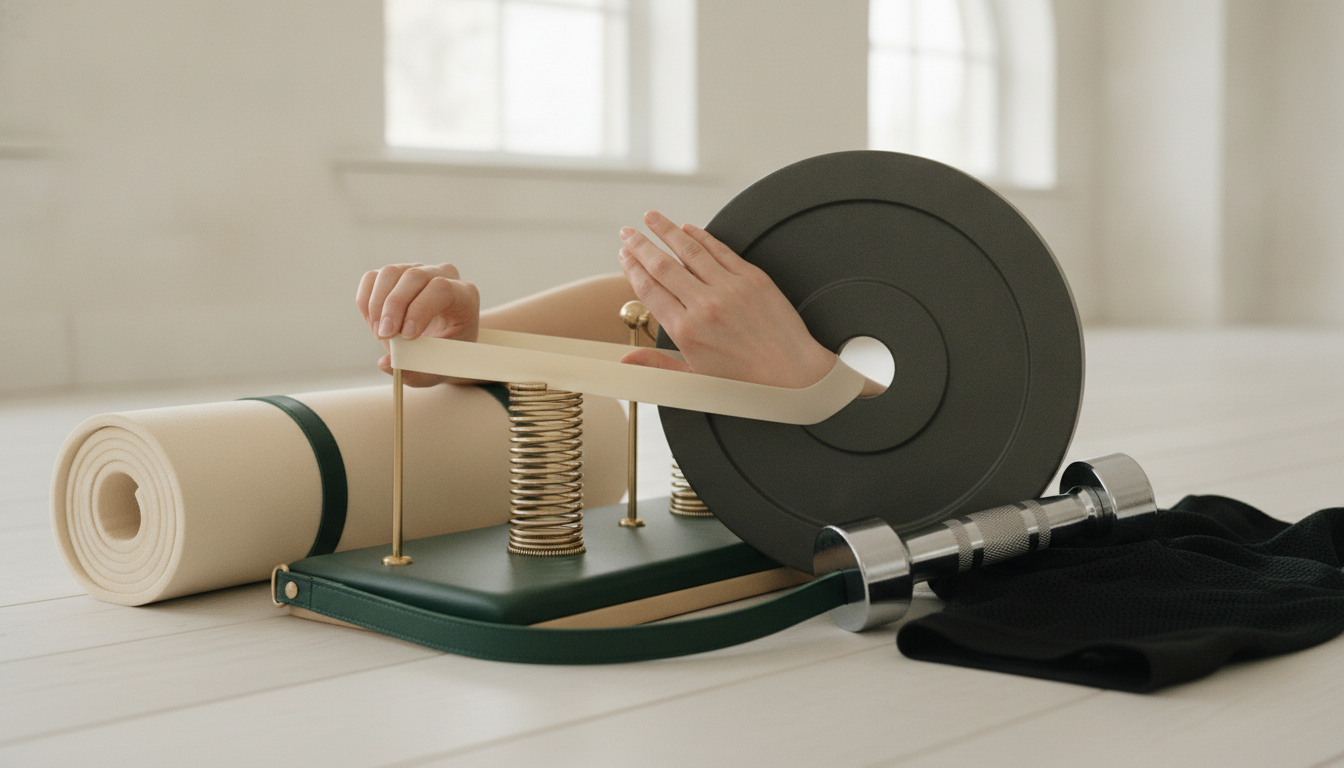
Choosing between Pilates and the gym depends entirely on your fitness goals. The gym is generally better for building maximum muscle size and raw strength through heavy lifting. Pilates is superior for developing deep core strength, improving posture, increasing flexibility, and building lean, functional muscle.
For many people, the best approach isn't choosing one over the other, but integrating both. Pilates can build the stable foundation that makes your gym workouts safer and more effective. This guide will break down the precise differences to help you decide which is right for you, or how to combine them for the best results.
Core Philosophies: Load vs. Control
To understand the difference in outcomes, we first need to look at the foundational approach of each method.
The Gym: A Focus on Progressive Overload
The fundamental principle of a traditional gym workout, especially weightlifting, is progressive overload. You challenge your muscles by lifting heavy weights, and to get stronger, you must systematically increase the load (weight), volume (reps/sets), or intensity over time. This forces the muscle fibres to tear and rebuild stronger and often larger—a process called hypertrophy.
- Method: Isolating specific muscle groups (e.g., biceps curls, leg press) or performing compound lifts (squats, deadlifts).
- Equipment: Barbells, dumbbells, kettlebells, and resistance machines.
- Goal: Increase maximal strength and/or muscle size.
Pilates: A Focus on Control and Precision
Pilates was developed by Joseph Pilates as a system of exercises called "Contrology." The focus is not on how much you can lift, but on how well you can control your body through a precise range of motion. It targets the deep, intrinsic muscles that stabilize the spine and joints—what we call the 'core' or 'powerhouse.'
- Method: Integrated, full-body movements that originate from a strong centre. Every exercise emphasizes concentration, control, breath, and precision.
- Equipment: Your own bodyweight (Mat Pilates), or spring-based resistance apparatus like the Reformer.
- Goal: Build core strength, improve posture, increase stability, and create balanced, lean muscle tone.
Pilates vs. Gym: A Head-to-Head Comparison
For the gym-goer, the results are what matter. Let's compare how each modality stacks up against common fitness goals.
| Feature |
Gym (Weight Training) |
Pilates (Reformer & Mat) |
| Muscle Building |
Winner. Ideal for hypertrophy and building significant muscle mass. |
Builds lean, defined, and elongated muscles. Not designed for bulk. |
| Core Strength |
Works superficial abs (e.g., crunches). Compound lifts engage the core for stability. |
Winner. The entire method is built around strengthening the deep core muscles (transverse abdominis, pelvic floor, diaphragm, multifidus). |
| Strength Type |
Develops maximal strength (your one-rep max) and explosive power. |
Develops functional strength, stability, and muscular endurance. Strength you use in daily life. |
| Flexibility & Mobility |
Can decrease flexibility if not paired with a dedicated stretching routine. |
Winner. Improves both flexibility (muscle length) and mobility (joint range of motion) through dynamic stretching and controlled movements. |
| Posture Correction |
Can worsen posture if imbalances are reinforced (e.g., over-training chest, under-training back). |
Winner. A primary benefit. Strengthens postural muscles and increases body awareness to correct imbalances. See our guide on Pilates for posture. |
| Injury Prevention |
Higher risk of injury due to heavy loads and potential for poor form. |
Winner. Low-impact and highly controlled, making it excellent for prehab and building the stability that prevents injuries in other activities. |
| Weight Loss |
High-intensity sessions can burn more calories during the workout. Building mass increases resting metabolism. |
Builds lean muscle, which raises resting metabolism. A full session is a significant calorie burn. Both support weight loss effectively. |
| Mind-Body Connection |
Generally low, with a focus on external load and hitting rep counts. |
Very high. Requires intense concentration on breath, form, and precise muscle activation. |
A Deeper Look at Your Fitness Goals
The table above gives a quick overview, but your specific goal deserves a more detailed look. Let's break down how Pilates and the gym serve the most common fitness objectives.
Objective 1: Building Maximum Muscle Size (Hypertrophy)
The Clear Winner: Gym
If your primary, undisputed goal is to get bigger—to add significant muscle mass—then a traditional gym-based weightlifting program is the most direct and effective path. The principle of progressive overload, which is the cornerstone of bodybuilding and strength training, requires you to systematically increase the stress placed on your muscles. This is most easily achieved by adding more weight to a barbell or dumbbell.
- How it works: Lifting heavy weights (typically in the 6-12 rep range to failure) creates microscopic tears in muscle fibers. The body then repairs these fibers, making them thicker and stronger to handle the stress next time. This process is called hypertrophy.
- Why the gym excels: The sheer load capacity of barbells and machines is unmatched. You can squat hundreds of kilograms, a load that is impossible to replicate in a Pilates session. This high level of mechanical tension is the primary driver of significant muscle growth.
Pilates will build muscle, but it's a different kind. It builds lean, defined, and incredibly resilient muscle through endurance and control, not through sheer size. You won't get bodybuilder-sized legs from the Reformer, but you will develop the deep stabilizing muscles that support powerful, efficient movement.
Objective 2: Developing Deep, Functional Core Strength
The Clear Winner: Pilates
This is where Pilates is in a class of its own. Many people in the gym think of "core work" as doing crunches, sit-ups, or leg raises. These exercises primarily target the most superficial abdominal muscle, the rectus abdominis (the "six-pack" muscle). While this muscle has its place, it's not the true source of core stability.
- How it works: Pilates focuses on the "inner unit" or "powerhouse." This includes the Transverse Abdominis (TVA), the pelvic floor, the multifidus, and the diaphragm. These muscles work together like a natural corset, stabilizing your spine and pelvis from within.
- Why Pilates excels: Every single Pilates exercise is initiated from and sustained by the engagement of this deep core system. The spring resistance of the Reformer provides constant feedback, forcing you to maintain this connection through every phase of movement. A heavy deadlift requires core engagement, but Pilates trains it with unmatched precision. This translates to a stronger back, better balance, and a more stable foundation for everything you do.
Objective 3: Weight Loss and Changing Body Composition
It's a Tie, But They Work Differently
Both the gym and Pilates are excellent tools for weight loss. They just achieve it through different mechanisms.
- The Gym's Approach (Calorie Burn & Metabolism): High-Intensity Interval Training (HIIT) and heavy compound lifting sessions can burn a very high number of calories in a short period. Furthermore, the significant muscle mass you can build in the gym raises your Basal Metabolic Rate (BMR), meaning you burn more calories even at rest.
- The Pilates Approach (Muscle Quality & Sustainability): A dynamic 50-minute Reformer class is a demanding workout that burns a significant number of calories. More importantly, Pilates builds lean muscle across the entire body. This metabolic tissue also contributes to a higher BMR. The key advantage of Pilates for many is its sustainability. It's low-impact, meaning you can do it consistently for years without the joint strain associated with high-impact gym workouts. Consistency is the most critical factor in any successful weight loss journey.
Objective 4: Improving Posture and Alleviating Pain
The Clear Winner: Pilates
Modern life, especially desk work, often leads to significant postural problems. While a well-designed gym program can help, a poorly designed one can make these issues worse. For instance, over-emphasizing "push" exercises (like bench press) without balancing them with "pull" exercises (like rows) can exacerbate rounded shoulders.
- How it works: Pilates directly targets the deep postural muscles that hold your skeleton in optimal alignment. It systematically identifies and corrects muscular imbalances. If your hip flexors are tight and your glutes are weak, Pilates exercises will simultaneously stretch the tight muscles and strengthen the weak ones.
- Why Pilates excels: The focus on body awareness is paramount. You learn to feel how you're standing and moving. This awareness carries over into your daily life. For specific issues like lower back pain from a desk job, the gentle, controlled movements can decompress the spine and build the support structure needed for long-term relief.
Equipment Deep Dive: Gravity vs. Springs
The tools used in each discipline create fundamentally different stimuli for your muscles.
A gym relies on gravity-based resistance. A 20kg dumbbell weighs 20kg whether you're lifting it or lowering it. The hardest part of the lift is typically the beginning of the concentric phase (the lifting part) when you have to overcome inertia.
Pilates, particularly on the Reformer, uses spring-based resistance. This is unique for several reasons:
- Variable Resistance: The further you stretch a spring, the more resistance it provides. This challenges the muscle through its entire range of motion.
- Eccentric Control: The springs want to recoil. This means you have to control the movement on the way back to the start (the eccentric phase) just as much as you did on the way out. This eccentric muscle contraction is key to building long, strong muscles and preventing injury.
- Assistance and Resistance: Springs can be used to add challenge or to assist with a movement, making exercises accessible to people at different fitness levels.
The Experience: Solo Training vs. Guided Practice
Your environment dramatically affects your consistency and results.
The gym is often an individual pursuit. You follow your own program, wear headphones, and focus on your lifts. While large group classes exist, the weight room floor is typically a solo space. This offers freedom but can lack guidance, leading to plateaus or improper form.
A boutique Pilates studio, like Veda Pilates, offers a different experience. Our classes are intentionally small. This allows the instructor to provide personalized feedback and corrections to every client throughout the 50-minute session. The focus is on quality of movement, not quantity of reps. This guided practice ensures you are working safely and effectively, which is crucial for seeing real results in posture and core strength.
Better Together: Why Gym-Goers Need Pilates
Instead of viewing it as an either/or decision, consider Pilates the perfect supplement to your gym routine. Many professional athletes use Pilates to gain a competitive edge. Here’s how it can enhance your lifts:
- A Stronger Core for Heavier Lifts: Your deep core is the foundation for every major lift. A stronger transverse abdominis acts like a natural weightlifting belt, stabilizing your spine during heavy squats and deadlifts, allowing you to lift more weight, more safely.
- Improved Mobility and Flexibility: Do you struggle to hit depth in your squat due to tight hips? Pilates improves your mobility, allowing for a greater range of motion and better form in your lifts.
- Injury Prevention: By correcting muscle imbalances and strengthening the small stabilizing muscles around your joints, Pilates makes you more resilient and less prone to the common strains and injuries that can derail a lifting program.
- Enhanced Mind-Muscle Connection: The intense focus required in Pilates teaches you to activate specific muscles with precision. This skill translates directly to the gym, helping you get more out of every single rep.
The Final Verdict: Which Path Is Yours?
So, which is better for you? The answer is in your primary goal.
Choose the Gym if:
- Your number one goal is to build significant muscle size (bulk).
- You are training for maximal strength, such as in powerlifting.
- You thrive in a high-intensity, self-directed environment.
Choose Pilates if:
- You want to build deep, functional core strength.
- Your goals are to improve posture, flexibility, and overall mobility.
- You want to build a lean, defined physique without adding bulk.
- You are recovering from an injury or looking to prevent future ones.
Choose Both if:
- You want a balanced, well-rounded fitness routine.
- You are a serious lifter who wants to improve your foundation, prevent injury, and break through plateaus.
- You want to combine the best of both worlds: the power of the gym and the precision of Pilates.
Experience the Difference in Ghaziabad
Reading about the benefits of a strong core is one thing; feeling it is another. If you're a gym-goer in Raj Nagar Extension, Raj Nagar, or Kavi Nagar, the best way to understand how Pilates can complement your training is to try it.
We invite you to discover how a focus on control and precision can unlock new levels of strength and stability. See how a 50-minute guided session can challenge you in ways you never expected.
Ready to build a stronger foundation for all your fitness goals? Book your trial class at Veda Pilates for just ₹999 and feel the difference for yourself.